Real Leather vs. Faux Leather: Is High-End Artificial Leather Really Worse? A Buyer's Guide
Table of Contents
The Short Answer
It depends on what you use it for. Don't judge by the name alone.
Top-grain leather is still very strong in feel, breathability, and tear resistance. That is why it has lasted for so many years. But high-end faux leather has improved fast. Water-based PVC, solvent-free PU, and silicone leather now beat real leather in many tests. These include hydrolysis resistance, stain resistance, color fastness, flame resistance, and daily care.
The real traps are at the two ends of the market. At one end is cheap, poorly made artificial leather. At the other end are "real leather" products that sound high-class but are actually split leather or bonded leather.
Ask yourself three questions before you choose: Where will you use it? How long do you want it to last? Who will take care of it? For sofas, car seats, commercial seating, baby products, and medical use, dirt, water, and heavy use are big problems. High-end faux leather is often easier here. For a personal bag, shoes, or belt, top-grain leather is still a good buy if you like the feel and are happy to care for it.
What Is Real Leather? What Is Faux Leather?
What Is Real Leather (Genuine Leather)?
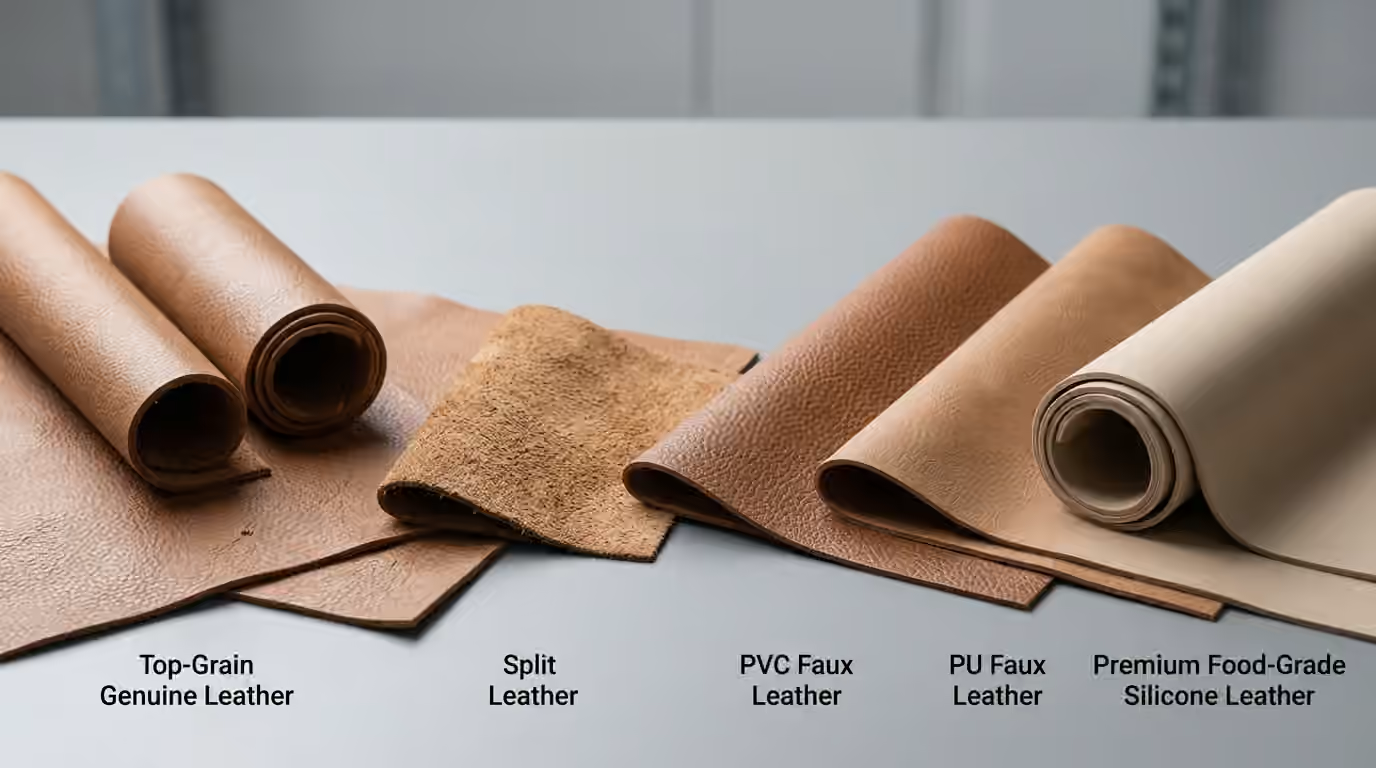
Real leather is animal skin that has been tanned. It keeps its natural fiber structure. By layer, the outer layer has pores and grain. It is called top grain (full-grain and corrected-grain leather both belong here). The lower layer that is cut away is called split leather. The two differ a lot in price and durability, but labels often call both "real leather."
The words "genuine leather" on a label do not mean high quality. Often they mean split leather, or leather with an embossed surface. Bonded leather is even easier to misunderstand. The U.S. Federal Trade Commission's leather guides require sellers to state how much of bonded leather is leather and how much is not. But the guides do not set a minimum amount of leather fiber. See the FTC leather guides in the Federal Register. So a product that says "contains leather" may have very little leather in it.
What Is Faux Leather (Synthetic Leather)?
Faux leather usually has two parts: a base fabric and a surface coating. The base is often knitted fabric, non-woven fabric, or microfiber. The coating decides what type it is:
- PVC leather: The oldest type of faux leather. It is cheap, wear-resistant, and waterproof. People think it feels the most "plastic." But water-based processes have improved it a lot.
- PU leather: Softer to the touch, and the most widely used type today. Solvent-free PU and water-based PU are the greener choices. Microfiber leather, which uses a microfiber base, also belongs to the PU family.
- Silicone leather: Uses silicone as the coating. It resists weather and stains, has little smell, and costs more.
Real Leather vs. High-End Faux Leather: Performance Comparison
Today I read an article that compares faux leather and real leather. Many of its claims seemed misleading to me, and some were almost pseudoscience. To make real leather look better, the article said faux leather always smells like plastic or chemicals and has no natural leather smell.
From my years in this industry, this is not accurate. It is true that cheap faux leather and good leather are very different in price. Some low-end faux leather is a bit worse in texture, smell, and feel. But that does not mean all faux leather is a low-quality petroleum-based material. It also does not mean faux leather always smells bad.
The comparison below uses good-quality real leather and faux leather. Real performance changes with process, formula, and thickness.
| Property | Split Leather | Top-Grain Leather | Water-Based Eco PVC Leather | Solvent-Free PU Leather | Eco Silicone Leather |
|---|---|---|---|---|---|
| Durability | ⭐⭐☆☆☆ | ⭐⭐⭐⭐⭐ | ⭐⭐⭐⭐⭐ | ⭐⭐⭐☆☆ | ⭐⭐⭐⭐⭐ |
| Hydrolysis resistance | ⭐☆☆☆☆ | ⭐⭐⭐⭐☆ | ⭐⭐⭐⭐⭐ | ⭐⭐⭐⭐☆ | ⭐⭐⭐⭐⭐ |
| Tear resistance | ⭐⭐☆☆☆ | ⭐⭐⭐⭐⭐ | ⭐⭐⭐⭐⭐ | ⭐⭐⭐⭐⭐ | ⭐⭐⭐⭐⭐ |
| Abrasion and scratch resistance | ⭐☆☆☆☆ | ⭐⭐⭐⭐☆ | ⭐⭐⭐⭐⭐ | ⭐⭐⭐⭐⭐ | ⭐⭐⭐⭐⭐ |
| Color fastness | ⭐☆☆☆☆ | ⭐⭐⭐☆☆ | ⭐⭐⭐⭐⭐ | ⭐⭐⭐⭐⭐ | ⭐⭐⭐⭐⭐ |
| Stain resistance | ⭐☆☆☆☆ | ⭐⭐⭐⭐☆ | ⭐⭐⭐⭐⭐ | ⭐⭐⭐⭐☆ | ⭐⭐⭐⭐⭐ |
| Flame resistance | ⭐☆☆☆☆ | ⭐⭐⭐☆☆ | ⭐⭐⭐⭐⭐ | ⭐⭐⭐⭐☆ | ⭐⭐⭐⭐⭐ |
| Heat and cold resistance | ⭐⭐⭐☆☆ | ⭐⭐⭐⭐☆ | ⭐⭐⭐⭐☆ | ⭐⭐⭐⭐☆ | ⭐⭐⭐⭐⭐ |
| Softness | ⭐⭐⭐⭐☆ | ⭐⭐⭐⭐⭐ | ⭐⭐⭐⭐☆ | ⭐⭐⭐⭐⭐ | ⭐⭐⭐⭐⭐ |
| Breathability | ⭐⭐⭐⭐☆ | ⭐⭐⭐⭐⭐ | ⭐⭐⭐☆☆ | ⭐⭐⭐⭐☆ | ⭐⭐⭐⭐☆ |
| Eco-friendliness | ⭐☆☆☆☆ | ⭐☆☆☆☆ | ⭐⭐⭐⭐☆ | ⭐⭐⭐⭐⭐ | ⭐⭐⭐⭐⭐ |
| Difficulty of care | High | High | Low | Medium | Low |
| Material cost | Medium | High | Medium-high | Medium-high | High |
Here is how to read the table, material by material.
Top-grain leather is strong in a few clear areas: feel, tear resistance, and breathability. Its weak points are fading in sunlight, poor eco-friendliness, and the need for care. You must look after it after you buy it. That is part of its cost of use.
Split leather is not the same as top-grain leather. It is cheaper, but it is much weaker in abrasion resistance, stain resistance, and color fastness. In long-term use, its surface layer can peel off. Many complaints that "real leather is not durable" actually come from split leather or corrected-grain leather.
Water-based eco PVC is strong in hydrolysis resistance, abrasion resistance, and flame resistance, and its cost is low. It is widely used in commercial seating and public places. Its weak points are average breathability and a feel that is a little worse than top-grain leather.
Solvent-free PU is very good in feel, breathability, and eco-friendliness. But its hydrolysis resistance and durability are only medium. This comes from the nature of PU itself. Good or bad craft makes a big difference.
Silicone leather scores high in almost every item. The price is high cost.
For the eco-friendliness row, there is also an outside signal you can check. The EU added Entry 76 to REACH Annex XVII. It limits the use and sale of dimethylformamide (DMF) at concentrations of 0.3% or above. DMF is a common solvent in PU coating processes. See TÜV's note on this REACH restriction and the ECHA restriction registry page. PU coating and film production also got one more year to comply. See the related study in ChemSusChem. This is the direct reason why solvent-free PU and water-based PU are getting more attention.
How to Tell Real Leather from Faux Leather
The short answer: your eyes and hands can no longer tell reliably. The safest way is to do a material test, or ask the supplier for a material statement.
The old tricks were to look at the grain, feel the surface, or burn a small piece and smell it. They worked more than ten years ago. They do not work now. PVC, PU, and silicone leather have improved fast. High-end faux leather can now match top-grain leather in softness and surface grain almost exactly. Ordinary people can hardly reach a reliable answer with eyes and hands alone.
Here is a real example from the industry: PVC eco-leather. Its base is "eco genuine leather" (a recycled base made mainly of leather fibers). A layer of polyvinyl chloride (PVC) resin is then put on top. Strictly speaking, it is faux leather. But when you burn it, you smell plastic and also a protein smell, much like real leather. People who judge by smell can easily think it is real leather.
So the old "look, touch, smell, burn" method is only a hint now. It is not proof.
The Market for Each Material Today
Data as of October 2026.
Do not treat these numbers as exact. Different research firms give very different sizes for the 2025 leather goods market, from about $250 billion to $550 billion. The main reason is what they count. Some include shoes and clothes. Some include faux leather and some do not. So below I only quote data from firms with public pages.
The Real Leather Market
Grand View Research estimates the global leather goods market at about $282.1 billion in 2025 and about $299.9 billion in 2026. Real leather goods make up 52.7% of it, still the biggest part. In the same report, the fastest-growing type is vegan leather (non-animal alternative materials). Real leather is not shrinking. Most of the new growth is simply going to alternative materials.
Footwear is where real leather and faux leather compete most directly. Grand View's synthetic leather report shows that footwear made up 29.1% of faux leather revenue in 2025. It is the biggest application. Sports and casual shoes use a lot of faux leather in the upper, lining, and insole.
Real leather must also pass compliance checks. EU REACH Annex XVII, Entry 47, says leather products that touch the skin must have hexavalent chromium below 3 mg/kg. The UK footwear and leather testing body SATRA has a clear explanation. Top-grain leather keeps its natural advantages. But "real leather means natural means no problem" is not true.
My view is that real leather is splitting into layers. Full-grain and high-quality top-grain leather will stay strong at the high end. Low-price products like split leather and bonded leather are now directly hit by well-made faux leather. In abrasion resistance, stain resistance, and color fastness, they mostly have no advantage.
The PVC Leather Market
PVC is the oldest faux leather. Grand View Research records that it appeared in 1920. People have used it for a hundred years for plain reasons: it is cheap, wear-resistant, waterproof, and hard to burn. The Grand View Research synthetic leather report splits faux leather into PU, PVC, TPO, and bio-based types. In 2025, PU held 57.0%, and the other three shared the rest. The report also says the industry is moving from a PVC-led mix to a mix of PU, bio-based, and recyclable materials.
PVC's home ground is places that do not need to "look like real leather." Examples are public seating, vehicle interiors, hotels, and medical places that need frequent wiping.
Its biggest compliance problem is plasticizers. Since July 7, 2020, the EU has required that DEHP, DBP, BBP, and DIBP (four phthalates) must each stay below 0.1% by weight in plasticized materials, or below 0.1% for their total. PVC is one of the materials covered, with a few exempted uses. For details, see the SATRA phthalate note and the TÜV SÜD explanation of the amendment.
So when you buy PVC leather, a phthalate test report is basically a must, and even more so if you export to Europe. Words like "water-based" or "eco-friendly" cannot replace a report.
The PU Leather Market
PU is the main force in faux leather. Grand View Research estimates the global faux leather market at about $45.5 billion in 2025 and about $50.6 billion in 2026. It expects about $115.4 billion by 2033, a yearly growth rate of about 12.5% from 2026 to 2033. PU holds 57.0%, with a yearly growth rate of about 12.4%. Other firms count differently. Precedence Research estimates about $53 billion for 2026, with growth around 8%. Grand View's growth rate is clearly higher. The numbers differ, but the direction is the same.
Automotive is the fastest-growing application. Grand View expects automotive use to grow about 13.2% a year from 2026 to 2033. The reasons include the growth of electric vehicles, weight reduction, steady quality, and the fact that faux leather works more easily with seat heating and ventilation holes.
You should also see the cost side. The report notes that in March 2026, Kuraray announced a price rise of more than 10% for its CLARINO artificial leather from April 1. It gave these reasons: higher costs for transport, labor, equipment upkeep, and raw materials. Faux leather will not always be cheaper. When you choose materials, include price swings in your plan.
The biggest change for PU in recent years is the solvent. Traditional dry and wet PU processes use DMF (dimethylformamide). EU regulation (EU) 2021/2030 added Entry 76 to REACH Annex XVII. When DMF is at 0.3% or above, it cannot be used or sold, unless the company keeps worker exposure below the set limit. This is not a total ban. It tightens the exposure limit. PU coating and film production first had a one-year grace period, which ended on December 12, 2024. Now the whole industry is under the new rule. This is the direct reason why solvent-free PU and water-based PU are mentioned so often these years.
Another old problem of PU is hydrolysis resistance. In hot and wet places, poor PU can peel and turn sticky within a few years. This comes from the material itself. Formula and process decide how long it lasts. Even when two products are both called PU, their life spans can be very different. So ask for a hydrolysis test report. Do not look at the name only.
The Silicone Leather Market
Silicone leather has the hardest data to find. I searched widely. Reports labeled "silicone leather market" give numbers from a few hundred million to tens of billions of dollars. Many of them actually count silicone additives for leather and textiles, not finished silicone leather. So I do not quote a market size here. What I can confirm is that it is still a high-end niche. It mainly appears where the needs for smell, flame resistance, and durability are strict.
Dow's LUXSENSE silicone leather is a good example. Dow's official page says it has no odor, low VOC, is flame-resistant by nature, and uses no solvent. It is used in transport seats and interiors, furniture, fashion goods, smart wearables, and consumer electronics. Dow supplies the silicone raw material, and chosen processing factories turn it into the finished leather.
The selling points of silicone leather are weather resistance, stain resistance, low odor, and flame resistance. The price is high cost. Quality also varies. If a "silicone leather" has no test report, treat it as ordinary faux leather.
Future Trend: Faux Leather Is Replacing Real Leather Step by Step
First, the direction: replacement is already happening. The speed differs, and each use case moves at its own pace.
The Growth Gap Shows That Replacement Is Happening
Look at the two materials from the same firm and the gap is clear. In Grand View's forecast for 2026 to 2033, faux leather grows about 12.5% a year, while the whole leather goods market grows about 8.7%. Precedence Research forecasts 2026 to 2035 growth of about 5.8% for leather goods and about 7.8% for faux leather. The numbers differ a lot from firm to firm, but the direction is the same: faux leather runs faster than real leather.
Real leather still holds about half of leather goods. The base is very large, so replacement happens slowly. It will not flip overnight.
Real Leather Supply Does Not Follow Leather Demand
Real leather has a built-in limit. Its raw material is a by-product of the livestock industry. Cowhide output follows meat consumption. It does not grow just because leather sells well. In its synthetic leather report, Grand View lists these as growth drivers for faux leather: controllable cost, consistent quality, and less exposure to raw hide price swings.
Faux leather has no raw hide limit. Output can grow with orders, and quality can be tuned by formula and process. Batches are more consistent. For big brands and large projects, this is a real advantage.
For Compliance, Faux Leather Can Simply "Change the Formula"
In recent years, EU rules have put demands on both sides. Real leather has the hexavalent chromium limit. PVC has the phthalate limit. PU has the DMF limit. The difference is how each side responds.
Most faux leather problems come from the formula and the solvent, and these can be swapped out directly. After the DMF limit, solvent-free and water-based processes became the main direction for PU. PVC can switch to a compliant plasticizer system. Silicone leather uses no solvent to begin with. In real leather, tanning and finishing chemistry are part of the process chain. There is less room to adjust, and it depends more on the specific tannery and batch control.
The next milestone is close. The EU's (EU) 2024/2462 limits PFHxA. From October 10, 2026, it applies to leather and textiles in clothing accessories and footwear. In 2027, it widens to other textiles and leather, such as sofas and curtains. Both sides use water- and stain-repellent finishes like these. Whoever finishes a new formula faster and has full reports will win more business. From what I see, faux leather makers usually change formulas faster.
Cars, Public Spaces, and Furniture: The Three Fastest Areas of Replacement
Cars are the clearest example. Grand View expects automotive use to grow about 13.2% a year from 2026 to 2033. The report also says Tesla has moved fully to faux leather interiors, and other carmakers are following. Emergen Research gives two clear reasons: electric vehicle cabins need less weight, and carmakers have material specifications that say "no animal materials."
In public transport, hotels, hospitals, and commercial seating, faux leather has been the main choice for a long time. These places need hydrolysis resistance, easy cleaning, flame resistance, and small color differences between batches. Real leather has no advantage on these points, and it costs more. Furniture and sofas are the next area being replaced, for a similar reason. At home, "no care needed" is a strong selling point by itself.
Brand and Consumer Attitudes to "Animal Origin" Are Changing
Vegan leather grows fastest. Behind this are price, and also a change in how people think. Grand View expects bio-based leather to grow about 14.5% a year from 2026 to 2033, the fastest of all types. The push comes from brands that want to cut Scope 3 emissions and make materials easier to trace. Some brands choose to use less real leather because of animal welfare and carbon footprint. Some younger consumers are also more open to high-quality synthetic materials.
But I want to warn readers about one trap here. "Not from animals" does not automatically mean "better for the environment." Most faux leather still uses petroleum-based raw materials. Bio-based content, recyclability, and service life decide its real environmental result. If you use a product for a long time and replace it less, that is itself the most practical way to be green.
The Order of Replacement: Mid-to-Low End and Commercial Use First
Putting these points together, I think replacement will go in this order:
- Mostly done: Public seating, vehicle interiors, medical and hotel materials.
- In progress: Car seats, furniture and sofas, sports shoes, and everyday shoes and bags. In these areas, the strengths of real leather (feel, breathability) compete directly with the strengths of faux leather (durability, easy care, price). High-end faux leather is taking more and more share.
- Slowest, and may stay for a long time: Luxury leather goods and high-end custom shoes. What they sell is the natural nature of the material and the brand story. Performance numbers are not the only reason to buy.
So a more exact way to say it is this: faux leather is gradually taking the place of real leather in the mass and commercial markets. Real leather will gather more and more in a few high-end uses where people care about "natural." For buyers, this means two things. Start testing and choosing faux leather early. And read the reports carefully, so that concepts do not lead you astray.
Final Note
Before you choose a material, think about three things: Where will you use it? How long do you want it to last? Who will take care of it? For a personal bag, shoes, or belt, top-grain leather is still a good buy if you like the feel of leather and are happy to care for it. For sofas, commercial seating, car interiors, baby products, and medical use, where dirt and water are big problems, high-end faux leather is often easier to live with, and its performance can even be stronger.
If you are choosing a material for a real project, tell us the use case, the expected life, and your budget. We will recommend faux leather by use case and give you the matching test data. Please contact us: Hualixing New Materials Co., Ltd.
FAQ
Q: How can I tell real leather from faux leather?
It is hard to tell by eye now. The old tricks, such as looking at the grain, feeling the surface, or burning a small piece and smelling it, are only hints. High-end faux leather can match top-grain leather in softness and grain almost exactly. Also, materials like PVC eco-leather have a base with leather fibers and a PVC resin surface. When burned, they give both a plastic smell and a protein smell, so people easily take them for real leather. The safest way is to do a material test, or ask the supplier for a material statement.
Q: Is faux leather always worse than real leather?
Not always. It depends on which real leather and which faux leather you compare.
Top-grain leather is still strong in feel, breathability, and tear resistance. But high-end faux leather (water-based PVC, solvent-free PU, silicone leather) already beats top-grain leather in tear resistance, hydrolysis resistance, stain resistance, color fastness, flame resistance, and daily care. Split leather and bonded leather cannot match well-made faux leather in these points. What is really bad is cheap, poorly made faux leather. Also bad are products called "real leather" that are actually split leather or bonded leather. When you choose, compare the specific material and its test data. Do not compare the two words "real" and "faux."
Q: Which faux leather is the most durable?
Overall, silicone leather and water-based PVC are the most reliable, and solvent-free PU is a little weaker. Silicone leather does best overall in hydrolysis resistance, abrasion resistance, weather resistance, tear resistance, stain resistance, and flame resistance. The price is high cost. Water-based PVC is also very strong in hydrolysis resistance, abrasion resistance, and flame resistance. It suits heavy-use places like public seating and vehicle interiors. Solvent-free PU has a good feel and is eco-friendly, but its hydrolysis resistance and durability are only medium. Be more careful when you choose it for wet places.
One reminder: the stars in the table are reference scores for typical processes. Different factories and different formulas of the same material can differ a lot. Before you place an order, ask the supplier for hydrolysis and abrasion test reports. This is more reliable than the stars.
Q: Which faux leather feels the best?
Solvent-free PU and silicone leather feel closest to top-grain leather. Water-based PVC is one step behind. PU is soft by nature. With a microfiber base, its touch, bounce, and drape are close to real leather. That is why PU is used most in shoes, bags, clothes, and furniture. Silicone leather has a soft, slightly skin-like surface, and it also feels good. PVC feels a bit harder, but water-based processes and foaming have improved it a lot. Feel also depends on the base fabric, thickness, foam layer, and surface finish. Different products of the same material can differ too. If feel matters a lot for your project, compare real samples. Do not rely on the material name only.
Q: Is every product labeled "real leather" top-grain leather?
No. The words "genuine leather" on a label do not mean high quality. Often they mean split leather, or leather with an embossed surface. Bonded leather is even easier to misunderstand, because it may contain only a small amount of leather fiber. The U.S. Federal Trade Commission's leather guides require sellers to state how much of bonded leather is leather and how much is not. But they set no minimum leather content. When you buy, look for a clear grade label, such as full grain or top grain, and then look for a material statement. If a product only says "real leather" or "genuine leather," do not assume it is top-grain.
Get a Free Quote
Hualixing New Materials Co., Ltd. is a factory-direct synthetic leather manufacturer with 30 years of manufacturing experience, specializing in OEM/ODM services. We manufacture and supply PVC leather, PU leather, silicone leather & vegan leather for automotive, furniture, upholstery, marine and more. Custom orders are available by yard or meter. Tell us your needs, and we will respond within 24 hours.